A Public Awareness Meeting on the 17th Decree of the Amir al-Mu’minin Was Held at Mola Ali Qari University.
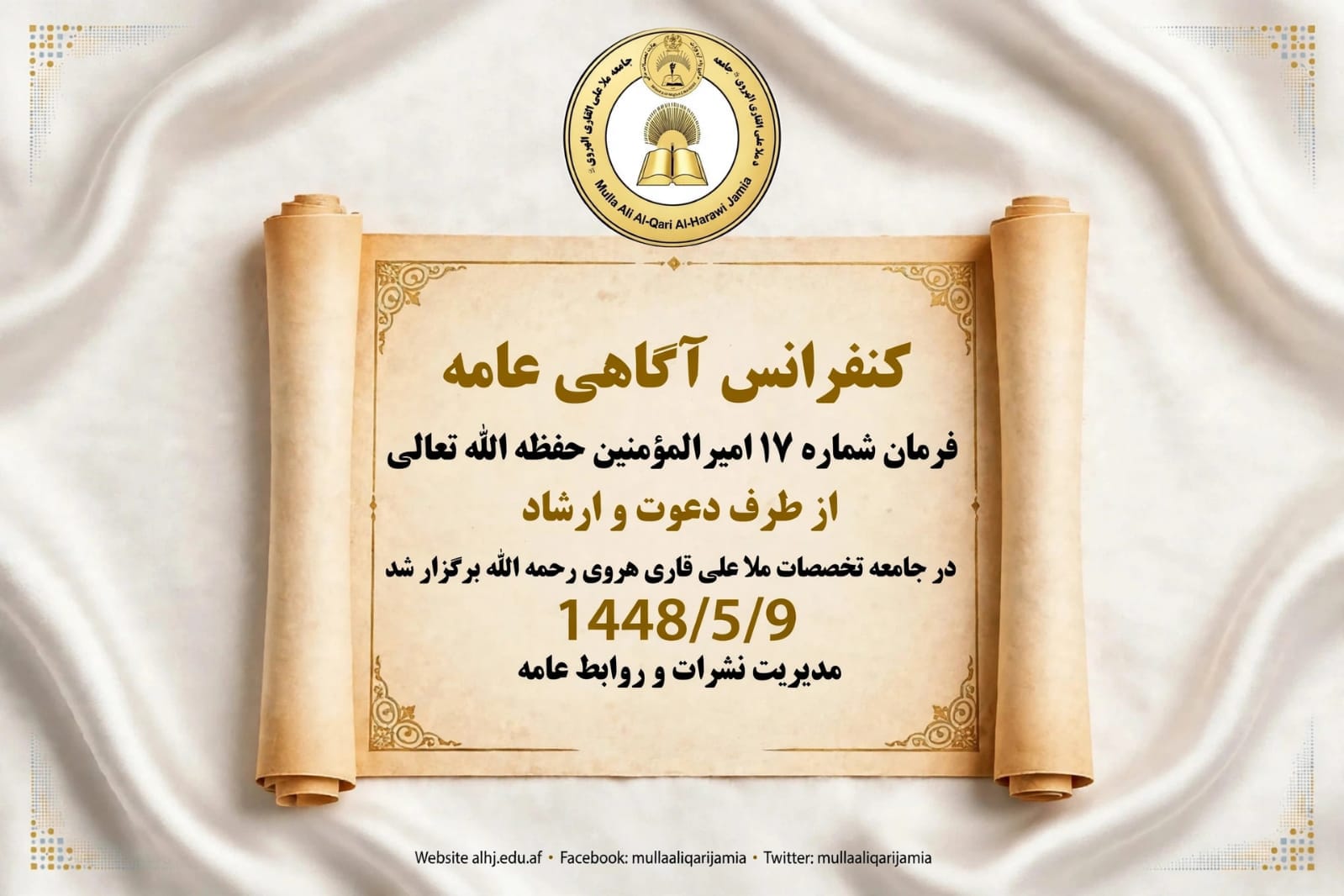
On Wednesday, a public awareness meeting concerning the 17th Decree of the Amir al-Mu’minin was held at Jami‘ah Mulla Ali Qari by the institution’s Department of Da‘wah and Irshad (Preaching and Guidance).
Sheikh Mufti Muhammad Tahir Naseh was invited to explain and elaborate on the decree. At the beginning of his speech, Mufti Sahib stated that we have fallen behind our time in many matters and face disagreements in various fields. One way to address these challenges is to implement the 17th Decree of the Amir al-Mu’minin.
He added that the decree begins with the following blessed verse:
“لَقَدْ كَانَ لَكُمْ فِي رَسُولِ اللَّهِ أُسْوَةٌ حَسَنَةٌ”
Translation: “Indeed, in the Messenger of Allah, you have an excellent example to follow.”
He also referred to a noble Hadith stating that whoever introduces something new into our religion that does not belong to it, that act is rejected and unacceptable. Allah Almighty also says:
“وَمَا آتَاكُمُ الرَّسُولُ فَخُذُوهُ وَمَا نَهَاكُمْ عَنْهُ فَانْتَهُوا”
Translation: “Whatever the Messenger gives you, take it, and whatever he forbids you, refrain from it.”
Mufti Sahib explained that any action consistent with the noble Hadith and the teachings of Sharia is acceptable; however, any action that contradicts them is rejected.
Our true test begins when we experience happiness or sorrow. When happiness comes, we must observe the principles of Sharia. Many customs have become deeply rooted in our society, making them difficult to abandon. Nevertheless, improper customs must be given up.
The noble Companions (may Allah be pleased with them) would remind one another of Surah Al-‘Asr and encourage one another to observe all the commandments of Islam. Allah Almighty says:
“وَذَكِّرْ فَإِنَّ الذِّكْرَى تَنْفَعُ الْمُؤْمِنِينَ”
Translation: “And remind, for indeed, reminders benefit the believers.”
He further explained that one of the improper customs prevalent in our society concerns the expenses and practices associated with engagement, marriage, and wedding ceremonies.
Explanation of Improper Customs Related to Marriage and Weddings
1. Excessive Expenditure on Marriage Ceremonies
A marriage that involves fewer expenses and less hardship is regarded as preferable in the Hadith. However, in our society, people often take greater pride and pleasure in weddings when more customs are observed and more money is spent. This is not appropriate, and such practices should be avoided.
2. Consent of the Bride and Groom
The consent of both the man and the woman is essential for marriage. A marriage conducted through force or coercion is not permissible. If such a case arises, the courts will hear the complaint and investigate the matter.
3. Mahr Is a Woman’s Sharia-Granted Right
Mahr (the obligatory marital gift) belongs to the woman, and her parents must not take it without her permission. Even if a woman willingly wishes to give her mahr to her parents, it should first be handed over to her so that she can make her own decision. It is preferable that her right to mahr be fully respected and not taken away.
4. Considering a Woman the Property of Another Person Because of a Particular Custom or Utterance
Some people follow a custom whereby, if a woman makes a particular traditional declaration or utterance directed at a man, she is then considered to belong to that man. This custom has no valid basis in Sharia.
5. Demanding Payment for Breastfeeding a Daughter
Some parents demand money from the groom or another person in return for having breastfed their daughter. This custom also has no valid basis in Sharia.
6. Customs of Exchanging Clothes
Certain customs involving the exchange or provision of clothes on the occasion of a wedding have no established Sharia basis. Such improper and unfounded customs should be avoided.
7. Holding Weddings in a Specific Month or on a Particular Date
The belief that a wedding must take place in a particular month or on a specific date is an improper custom. Marriages should be conducted in accordance with the teachings of Sharia, rather than unfounded traditions.
8. Using Government Vehicles for Wedding Ceremonies
Government vehicles belonging to the Islamic Emirate should not be used for wedding ceremonies.
9. Reckless Driving During Weddings
Racing vehicles and driving carelessly during wedding celebrations are undesirable practices and must be avoided.
10. Shighar Marriage (Mukhī)
Shighar marriage, known in some areas as Mukhī, is an improper practice that should be avoided.
Conclusion
At the conclusion of his speech, Mufti Sahib emphasized that any practice lacking a valid basis in the sacred Sharia should be completely avoided, as improper customs can have serious and harmful consequences. Muslims should align their lives, particularly matters concerning engagement, marriage, and wedding ceremonies, with the principles and teachings of Sharia.
Department of Publications and Public Relations
Date: 9/5/1448 AH (Wednesday)
